
Author: Carlos Tapia, Nordregio
The GRANULAR project has introduced a groundbreaking tool to better understand and address transport poverty in rural Europe: the Transport Poverty Risk Index (TPRI). This high-resolution index, developed by Nordregio researchers Carlos Tapia and Karina Maria Berbert Bruno, integrates climate risk frameworks with local socioeconomic data to pinpoint where rural mobility challenges are most acute. By combining energy price trends, public transport access, and demographic factors, the TPRI offers policymakers a dynamic, spatially nuanced lens to tackle rural transport poverty risks.
Building the Index: Data Meets Risk Analysis
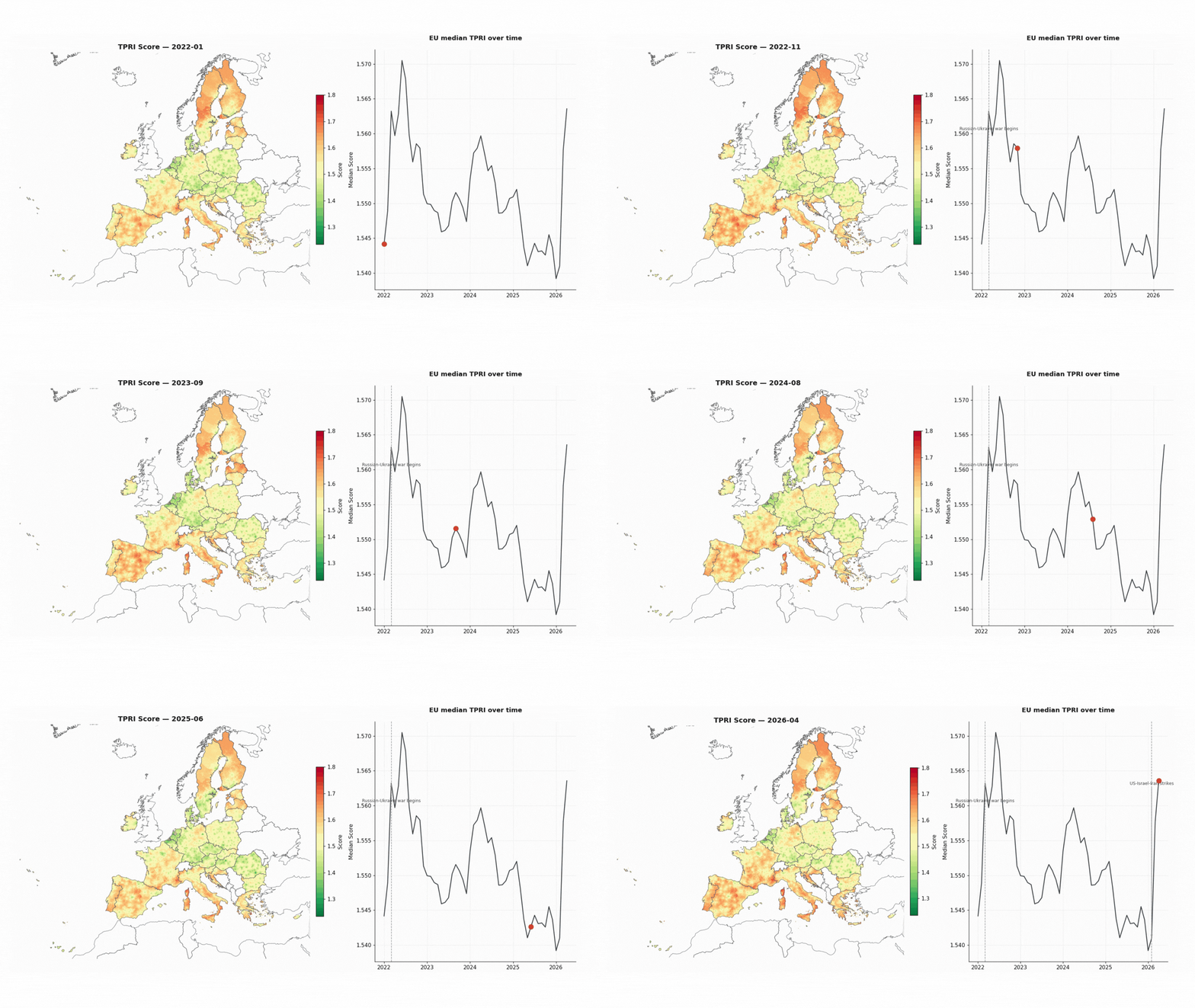
The TPRI builds on the IPCC’s Risk Framework, framing transport poverty as an interplay of Hazard (transport cost pressures like fuel and electricity prices), Exposure (dependence on private vehicles or limited public transit), and Vulnerability (income levels, aging populations, and socioeconomic fragility). To build the TPRI, API-based energy-price data retrieved from ENTSO-E (electricity) and the Weekly Oil Bulletin (fossil fuels), were first intersected with data on fleet composition from Eurostat to calculate a normalised “fuel-cost per kilometre” indicator. This information is then combined with official statistics and GRANULAR-produced accessibility datasets to create a comprehensive transport poverty risk index. Advanced statistical techniques based on Principal Component Analysis and Factor Analysis are used to weight all indicators to reflect their unique contributions, while a geometric mean ensures balanced aggregation. Implemented at high spatial resolution (1 km x 1 km) and monthly frequency for the period 2022-2026, the GRANULAR TPRI offers detailed insights into how transport poverty risk evolves spatially across Europe’s rural areas.
Stability Amid Change: A European Baseline
From 2022 to 2026, the evolution of the TPRI was mostly driven by fuel-cost exposure, which peaked in the aftermath of the full-scale invasion of Ukraine by Russia, and the US war on Iran in 2026. In spite of these fluctuations, the European median TPRI score remained remarkably stable, reflecting a delicate balance between rising motorisation and ageing populations, declining fuel-cost exposure post-2022 peak, modest income growth, and minimal shifts in public transport provision. While this stability might suggest uniform risk, it masks stark territorial disparities. Areas with high reliance on private transport, high poverty rates, or sparse transit networks often face compounded vulnerability, even as national averages appear steady.
Local Nuance: Insights from the GRANULAR Living Labs
Zoom-in analyses in GRANULAR Living Labs reveal that rural areas may remain structurally vulnerable despite aggregate stability. For example, many areas in the Ourense region show simultaneous decline of motorisation and public transport use; Pays Pyrénées highlights fuel-cost exposure’s significance in shaping risk dynamics; The Italian district of Val di Cecina emphasises the importance of considering both regional stability and higher risk scores in inland and less accessible areas when factors like motorisation, poverty risk, and fuel prices increase. In the Dutch Living Lab, higher TPRI scores are concentrated in Groningen, Friesland, and Flevoland compared with Overijssel and Gelderland. In West Pomeranian, the index increases slightly and higher scores are concentrated in peripheral inland areas farther from the main urban centres. In Upper Norrland remote and sparsely populated areas remain structurally vulnerable because of long distances, reduced public transport availability, car dependence, and demographic ageing.
Why It Matters: Beyond Affordability
The TPRI transcends simplistic affordability metrics, revealing transport poverty as a multidimensional phenomenon. Structural factors—such as accessibility to urban centers, demographic ageing, and income inequality—create entrenched vulnerabilities, while dynamic shocks like fuel price spikes can exacerbate risks. This duality informs tailored policy solutions:
- Fuel-cost hotspots: Targeted affordability support and gradual transitions towards renewable fuels with lower price volatility.
- Accessibility gaps: Invest in local services, demand-responsive transport, or digital connectivity.
- Vulnerable groups: Prioritise social safety nets for low-income households, the elderly, and lone parents.
Limitations and Future Directions
Despite its strengths, the TPRI measures risk conditions, not realised transport deprivation. High-risk zones may lack observed poverty despite coping mechanisms, while localised data gaps (e.g. national-level indicators) limit granularity. Future work should refine indicators for household-level constraints, validate against real-world mobility outcomes, refine resolution of input indicators and integrate service frequency data to capture local public transport realities.
Conclusion
The GRANULAR TPRI equips policymakers with a spatial diagnostic tool to address transport poverty’s root causes, emphasising that rural challenges demand place-based, adaptive strategies. By bridging high-frequency energy data with territorial analysis, it enables timely responses to fuel shocks, decarbonisation impacts, and shifting mobility costs. While limitations remain, the index underscores the need for nuanced, data-driven policies that balance affordability, accessibility, and equity in Europe’s rural heartlands. As climate pressures and economic volatility intensify, tools like the TPRI will be vital in ensuring no community is left stranded on the margins of mobility.
The TPRI background report, data and code can be retrieved from the following Zenodo repository: https://doi.org/10.5281/zenodo.21352798
This report, part of the GRANULAR project, aims to empower rural actors with actionable insights for inclusive, sustainable development.