
Author: Merveille Ntabuhashe (AEIDL)
Rural areas are central to Europe’s ambition to achieve climate neutrality by 2050. Covering nearly 80% of the EU’s territory and hosting vast natural resources, rural regions hold enormous potential for climate mitigation and adaptation. Yet, they remain underserved by monitoring tools and policy frameworks largely designed for urban contexts.
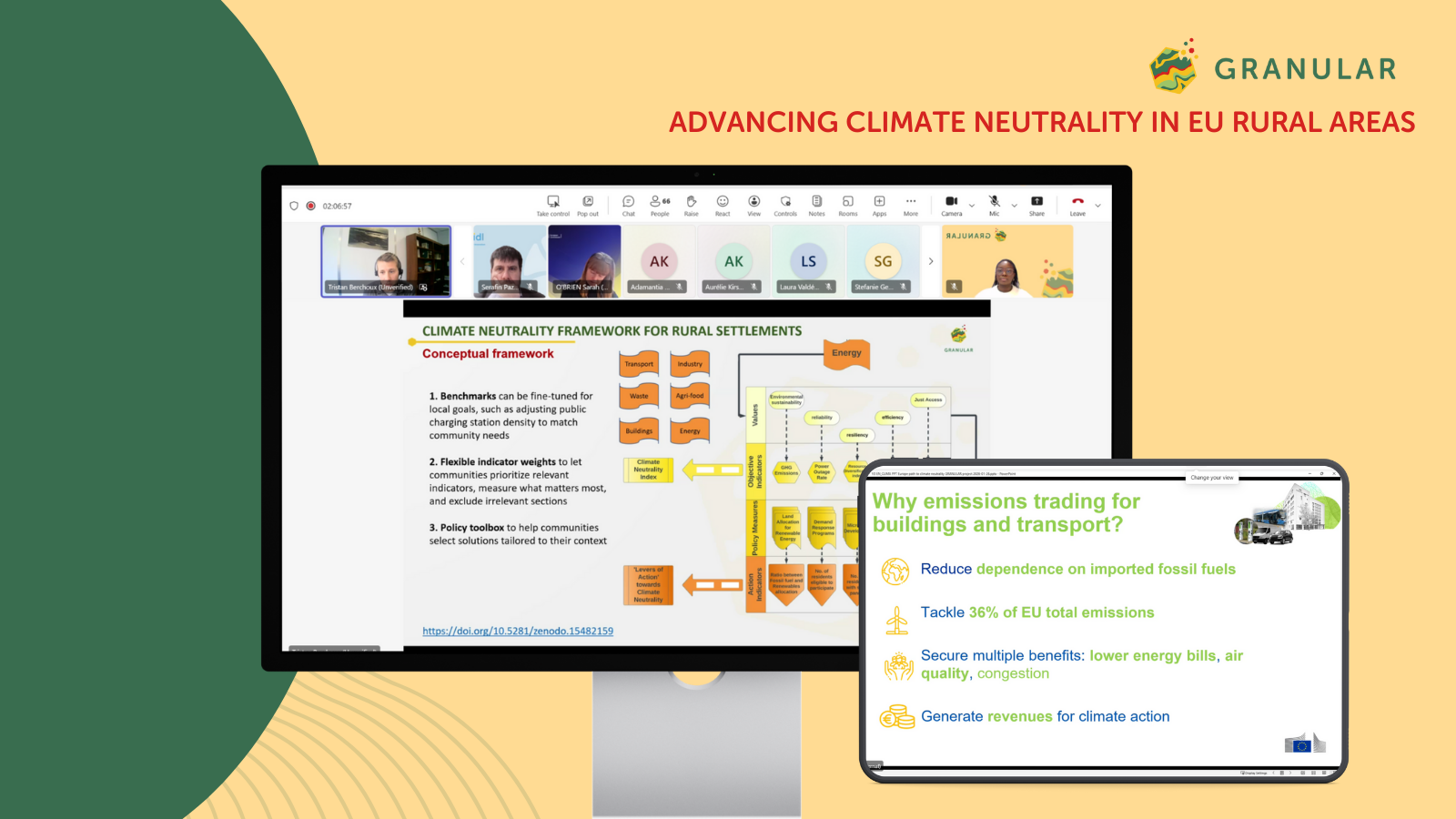
To address this gap, GRANULAR Knowledge Transfer Accelerator hosted a webinar this morning on “Advancing Climate Neutrality in EU Rural Areas”. Organised by the European Association for Innovation in Local Development (AEIDL), the session brought together over 77 stakeholders to highlight this challenge and showcase concrete solutions enabling rural communities to become full actors in the green transition.
A shared European framework for rural climate neutrality
Sarah O’Brien from the European Commission’s Directorate-General for Climate Action (DG CLIMA) provided an overview of Europe’s pathway to climate neutrality, underlining the importance of aligning EU climate instruments, such as the EU Green Deal, EU Emissions Trading System 2 (ETS2, and the Social Climate Fund, with the realities of rural territories.As she put it: “Making sure the transition isn’t done to or for rural communities, but with them, really resonates.”
Tristan Berchoux from Mediterranean Agronomic Institute of Montpellier, presented GRANULAR Climate Neutrality Framework. Developed within the GRANULAR project, the framework offers a standardised and locally sensitive methodology to measure and monitor climate neutrality in rural areas, covering domains such as energy, mobility, agriculture, and waste.
Fully aligned with the EU’s Long-Term Vision for Rural Areas (LTVRA), the framework ensure coherence between local climate action and broader EU resilience and sustainability objectives. He highlighted the importance of such tools to move from ambition to implementation, enabling rural authorities to design, track, and refine evidence-based climate strategies.
From frameworks to real-world innovation
The session also demonstrated how GRANULAR work is feeding into the next generation of Horizon Europe initiatives, by introducing two newly founded projects, bothbuilding onresults from GRANULAR on climate neutrality.
Fernando Veiga (University of Vigo) introduced STORCITO, a newly launched project supporting rural communities in becoming climate-neutral, resilient, and inclusive. The project translates indicators into action through three large-scale case studies addressing wildfire prevention, community energy systems, and climate-neutral rural mobility. With pilots spanning Atlantic, Mediterranean, Boreal, and Continental regions, the project illustrates how place-based innovation can respond to pressing rural challenges such as fire risk, energy poverty, and mobility gaps, while remaining scalable across Europe.
In addition, Pedro Martinez (Research to Market) presented the ICONICproject, which focuses on energy independence and climate neutrality in rural and island communities. ICONIC highlights how geographically isolated areas can turn vulnerability into strength by leveraging renewable energy, digital tools, and advanced control systems to become self-sufficient and climate resilient.
Key conclusions and next steps
The discussion highlighted a shared understanding that rural areas require tailored approaches to climate neutrality, as existing tools often fail to capture their specific characteristics, such as land use patterns, agricultural systems, and low-density mobility. Participants stressed that robust and shared frameworks are essential to turn ambition into action, with common indicators playing a key role in aligning local strategies with EU climate objectives.
Speakers also underlined that innovation must be place-based and inclusive, demonstrating that co-designed solutions grounded in local knowledge are more effective and socially just. They also highlighted that greater policy coherence is crucial, calling for stronger integration across environmental, social, energy, and mobility policies to ensure a fair and effective transition toward climate-neutral rural territories across Europe.