
Author: Gundi Knies, Thünen-Institute of Rural Studies
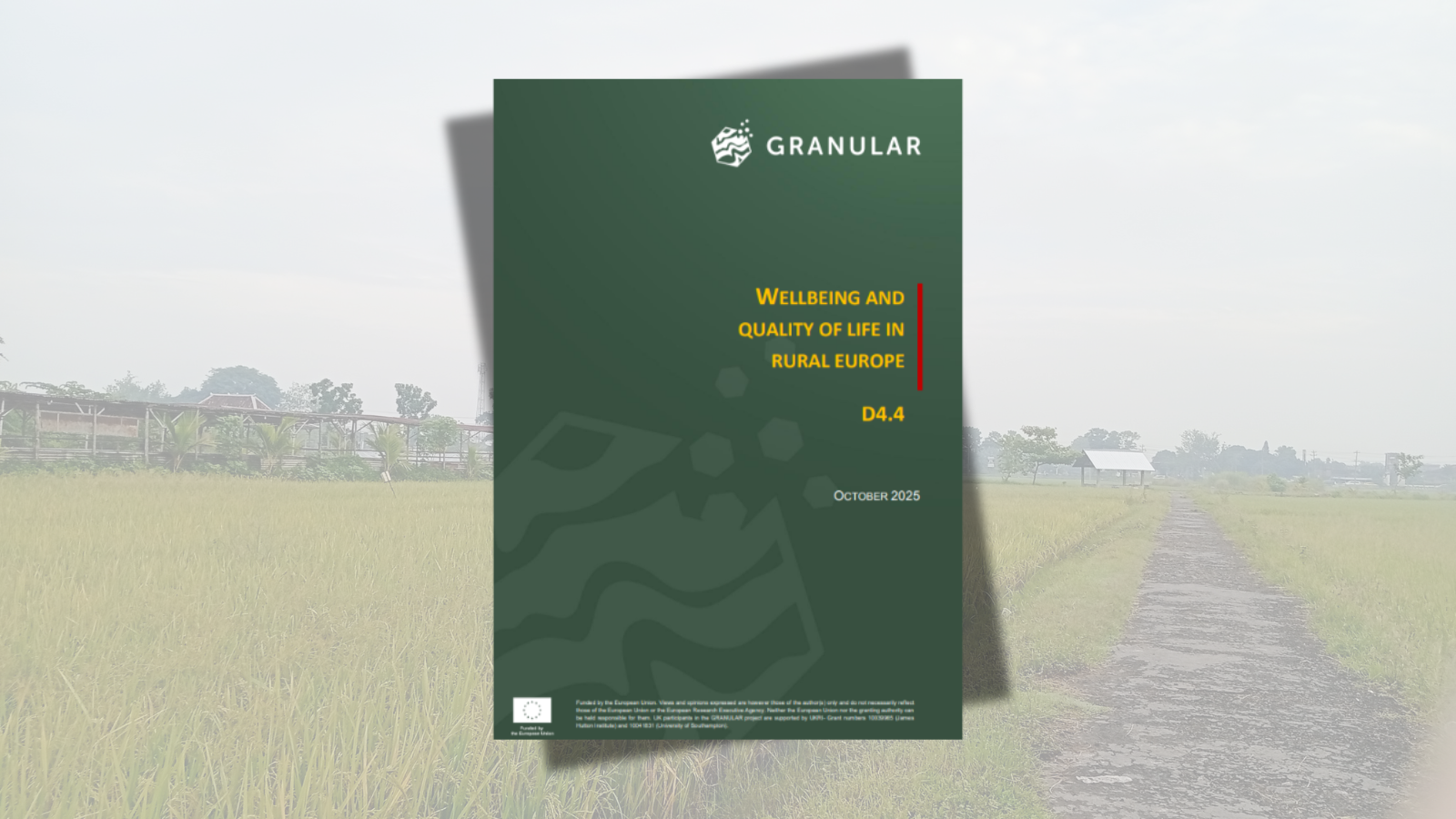
Wellbeing, fairness, and resilience are central goals of the European Commission’s Long-Term Vision for Rural Areas (LTVRA), yet the drivers of wellbeing remain complex and poorly understood. The recently published GRANULAR report “Wellbeing and Quality of Life in Rural Europe”, produced by partners from Thünen-Institute and James Hutton Institute, provides new evidence by examining how subjective wellbeing varies across rural and urban contexts in Europe and what this means for rural development.
Why rural wellbeing matters
Subjective wellbeing (SWB) has several dimensions:
- Evaluative and affective wellbeing: life satisfaction and daily mood
- Psychological resources: resilience, optimism, autonomy and coping
- Social wellbeing: trust, cohesion and belonging
Each dimension responds differently to local conditions. Environmental quality can support daily mood; social embeddedness can strengthen cohesion; and economic pressures can lower life satisfaction. Many rural areas benefit from strong networks and a sense of belonging, which can offset limited services or lower incomes. At the same time, informal support has limits, and overall wellbeing depends on how well individual needs and preferences align with the local environment.
What the evidence shows
Drawing on the European Social Survey (ESS), the UK Household Longitudinal Study (UKHLS/Understanding Society), and the German Socio-Economic Panel (SOEP), the report brings together unprecedented levels of geographical detail and wellbeing data. Four main findings stand out:
- Rural wellbeing advantages are real but uneven
Rural residents tend to report higher levels of social wellbeing, greater trust and better mental resources such as resilience and optimism. However, differences in life satisfaction and emotional wellbeing often shrink once we consider age, income, welfare systems or national context.
- Definitions of “rural” strongly shape results
Whether someone considers themselves to live in a “village” or “countryside,” or is classified as living in a low-density region or a rural municipality, can change the outcome. The self-reported settlement type often reveals a clearer rural advantage than population-based administrative classifications. This finding supports the GRANULAR project’s emphasis on fine-grained, place-based data.
- Very local context matters
Rural areas in Great Britain show a clear advantage in life satisfaction, but this advantage depends strongly on neighbourhood conditions. Neighbourhood deprivation lowers life satisfaction, but more so in urban areas than in rural areas. Rural residents appear to benefit from high environmental quality, stronger attachment to place or a more “cosmopolitan” local character. These findings show that rural context matters, but its effects are often subtle, and they highlight the value of rural-sensitive spatial data.
- Rural development comes with trade-offs
A German case study on wind turbines illustrates that proximity to turbines can reduce physical wellbeing, but larger turbines may increase wellbeing, possibly, because they bring noticeable community benefits. High turbine density, however, negatively affects mental wellbeing. The message is clear: development must be participatory, carefully planned and sensitive to local expectations.
Why this matters for policy and rural development
Wellbeing and quality of life are shaped not only by economic factors such as income and wealth, but by the social and environmental fabric of places. As Europe prioritises more resilient and inclusive rural areas, subjective wellbeing offers a powerful lens for understanding what rural communities value. For policymakers, several lessons emerge:
- Go beyond rural-urban binaries: Rural areas are diverse; policies and data systems must reflect this.
- Strengthen local services and reduce deprivation: These factors consistently support wellbeing.
- Plan development with communities: Renewable energy, housing or service restructuring should be pursued with engagement and benefit-sharing to avoid undermining wellbeing.
GRANULAR’s Multi-actor Labs support this effort by providing local spaces for collaboration, where communities, researchers, and authorities can explore issues together and ensure that rural-sensitive evidence informs better rural proofing and planning.
Looking ahead
Future work should expand geographic coverage, harmonise subjective wellbeing measures and make better use of geocoded and longitudinal data to understand how wellbeing changes over time. Most importantly, it should link wellbeing outcomes directly to policy interventions to see what works in practice.
Europe’s rural areas already offer many strengths. With more granular data, place-sensitive policymaking and deeper community engagement, the wellbeing potential of rural Europe can be realised more fully and more fairly in the years ahead.
Download the full report “Wellbeing and Quality of Life in Rural Europe” and learn more about GRANULAR.